University Ecologies Event: Against Animal Objectification, 9/24
474 Boston Avenue
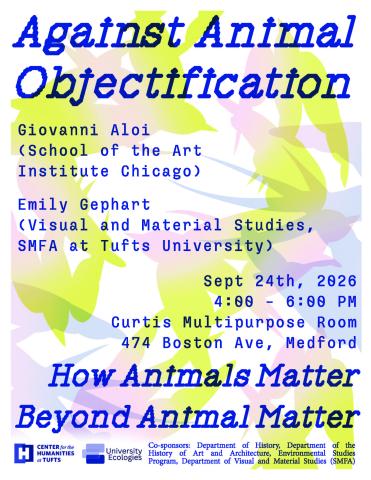
University Ecologies and the Question of the Commons invites you to a special event featuring
Giovanni Aloi (SAIC)
Emily Gephart (SMFA)
Against Animal Objectification. How Animals Matter Beyond Animal-Matter
Sept 24th, 2026, 4:00 PM - 6:00 PM
Curtis Multipurpose Room, 474 Boston Avenue, Medford, MA 02155
Co-sponsors: Department of History, Department of the History of Art and Architecture, Environmental Studies Program, Department of Visual and Material Studies (SMFA).
Emily Gephart's scholarship spans many forms of visual culture: she has published and presented on how new scientific approaches to the unconscious mind informed the work of American artists and critics in the early 20th century; on poetic satire and pictorial criticism of modernism in the 1916 Spectra hoax; on transatlantic encounters with the oceanic commons in art; on coordinated human and animal aesthetics in millinery fashion; and on the fabrication and perception of fly fishing lures, among other examples of 19th century 'ecologies of mind.
Giovanni Aloi's research focuses on the Anthropocene and new conceptions of nature in art. He currently teaches at the School of the Art Institute of Chicago and is the Editor in Chief of Antennae: The Journal of Nature in Visual Culture (www.antennae.org.uk). Aloi is the author of Art & Animals (2011), Speculative Taxidermy: Natural History, Animal Surfaces, and Art in the Anthropocene (2018), Why Look at Plants? The Vegetal Emergence in Contemporary Art (2019), Lucian Freud – Herbarium (2019), Posthumanism in Art and Science (2020), Vegetal Entwinements in Philosophy and Art (edited with Michael Marder, 2023), Estado Vegetal: Performance and Plant-Thinking (2023), Botanical Revolutions: How Plants Changed the Course of Art (2025), Lawn (2025), and I'm Not an Artist: Reclaiming Creativity in the Age of Infinite Content (2025). He has contributed to PBS TV and BBC radio programs, worked at Whitechapel Art Gallery and Tate Galleries in London, and currently is USA correspondent for Esse Magazine. Aloi has curated exhibitions in the US and Europe and is co-editor of the University of Minnesota Press series 'Art after Nature'.
In their talks, Prof. Aloi and Prof. Gephart will discuss the ways that art and visual culture have both contributed to and pushed against forms of animal objectification. Their presentations will be followed by a discussion session and Q&A.
Abstracts:
A Few Words on Birds: Beyond Avian Commodification
Emily Gephart (Visual and Material Studies, SMFA at Tufts University)
Birds have long been enmeshed in extractive networks through which avian matter has been turned into consumable goods: on hats, as fertilizer, and as aestheticized possessions. In the long 19th century and beyond, their bodies, their feathers and even their excrement were pivotal products with which industrializing humans traded, and in which visual and material culture play key roles. This talk presents three case studies in how people have regarded birds as things, subject to objectification via representation and transformation. But, moving beyond conventional histories of exploitation, each case study also reveals interwoven human and more-than-human fortunes. When we tell stories that re-center animal agency in extractive histories, we gesture towards common relational interdependencies between the bird world and our own.
Uncontainable Animalities
Giovanni Aloi (School of the Art Institute of Chicago)
What happens to an animal when it enters the gallery? Whether alive or preserved after death, its presence is shaped by conventions of display that make it available to human scrutiny and interpretation. This talk examines animal objectification as a persistent tension within contemporary art and asks how artists might unsettle the conditions that sustain it. Moving between living animals and works incorporating animal remains, we consider strategies that interrupt the possessive gaze and complicate the reduction of animal bodies to artistic materials. Particular attention falls on encounters in which bodily vulnerability or material presence exceeds the meanings assigned to the work. At stake is how artistic practice might negotiate its own implication in objectification while opening space for more attentive relationships with the beings whose lives and deaths become entangled with the politics of the white cube.